
Remember when “working from home” was the big workplace debate? That’s no longer the main concern. Today, we’re talking about AI teammates, virtual reality meetings, and workplaces that exist entirely in the cloud. And honestly? It’s both incredibly exciting and a little overwhelming.
If you’re wondering how technology is reshaping work culture in 2026 (and whether your company is keeping up), you’re not alone. Let’s break down what’s actually working, what’s causing headaches, and what you need to know to stay ahead.
The Digital Divide Is Closing In
According to McKinsey’s 2025 Future of Work Report, 87% of executives say their companies won’t survive the next five years without fundamental digital transformation.
The good news? The tools available today make this transformation more accessible than ever. The challenge? Figuring out which changes actually matter for your team.
5 Game-Changing Benefits That Are Actually Delivering Results
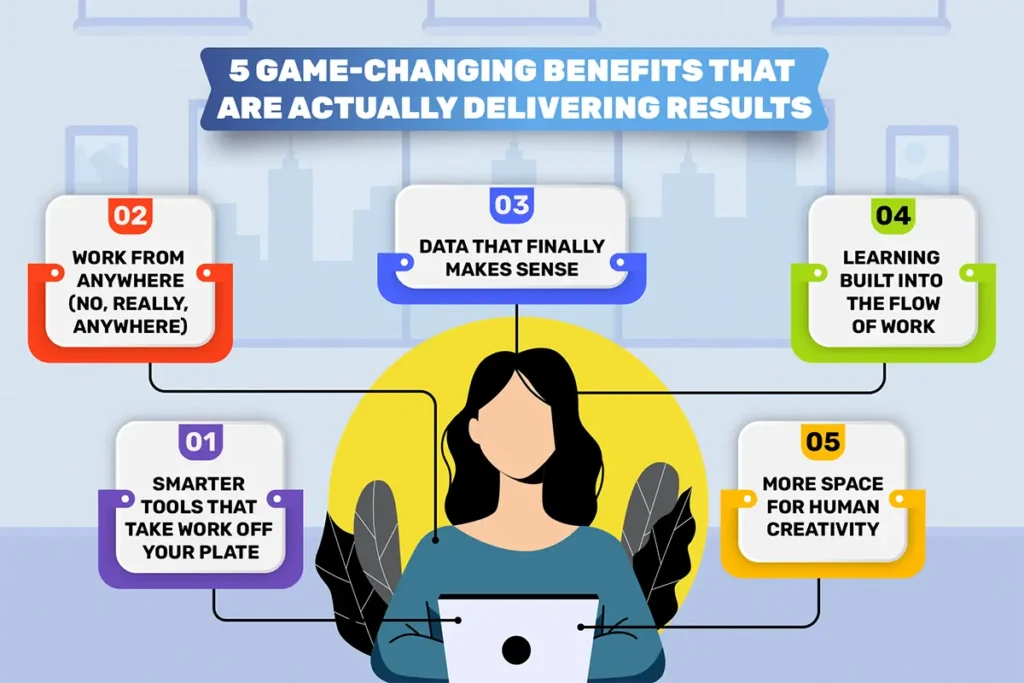
1. Smarter Tools That Take Work Off Your Plate
Instead of replacing people, today’s technology is quietly removing the tasks everyone dreads. From auto-generating meeting notes to streamlining data entry, these tools free up time for more meaningful work.
In action:
- Developers using GitHub Copilot report coding 55% faster
- Marketing teams using Jasper and Copy.ai produce 3x more content without burnout
- Financial analysts report processing data 10x faster with AI-powered dashboards
Quick win: Start with one small repetitive task your team dislikes, such as note-taking with Notion AI or transcription with Otter.ai.
2. Work From Anywhere (No, Really, Anywhere)
The “anywhere economy” is no longer about just working from your kitchen table. Teams are collaborating smoothly across time zones, languages, and even continents.
What’s making it possible:
- Real-time translation that understands nuance
- Asynchronous platforms that keep projects moving around the clock
- Virtual workspaces that feel more engaging than video calls
Companies using platforms like Gather and Horizon Workrooms report 40% better team cohesion compared to traditional setups.
3. Data That Finally Makes Sense
Drowning in spreadsheets is yesterday’s problem. Today’s analytics tools highlight the signals that actually matter, making decision-making faster and less stressful.
Examples:
- Workday’s Skills Cloud identifies skill gaps early
- Monday.com suggests workflow improvements based on usage patterns
- Slack analytics reveal when your team is most productive and when they need a break
4. Learning Built Into the Flow of Work
With technical skills turning over every 2.5 years, learning can’t be something you put off for later. The best companies now weave learning directly into the workday.
How it looks:
- Microsoft Viva recommends training in real time
- Digital mentors offer coaching while you work
- Microlearning platforms deliver 5-minute lessons between meetings
5. More Space for Human Creativity
When technology handles the routine, people can focus on the work that energizes them: creativity, problem-solving, and connection.
A Deloitte study found companies with high automation adoption saw employee satisfaction increase by 31 percent because workers could spend more time on meaningful projects.
But There Are Challenges…
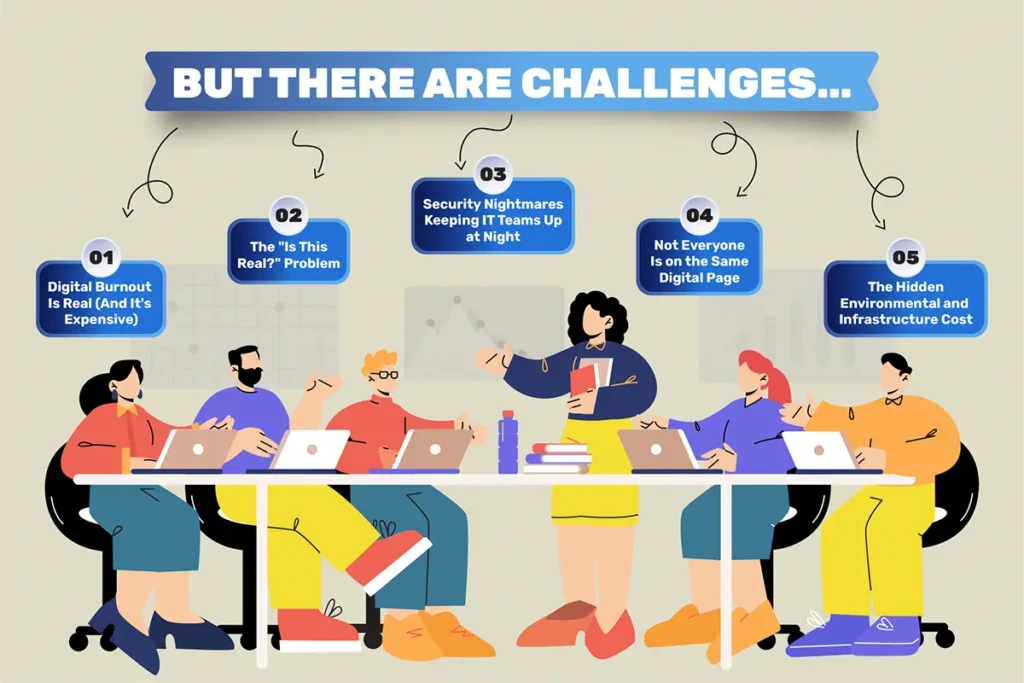
1. Digital Burnout Is Real (And It’s Expensive)
Let’s be honest: being “always on” is exhausting. The average knowledge worker now juggles 12 different communication platforms. That’s not productivity. That’s chaos.
What forward-thinking companies are doing:
- Implementing “deep work blocks” where notifications are completely turned off
- Setting core collaboration hours (and respecting them)
- Using tools like Clockwise to automatically protect focus time
- Creating “no meeting Fridays” that actually stick
2. The “Is This Real?” Problem
When AI can write emails, create presentations, and even attend meetings for you, authenticity becomes a real concern. Customers and employees alike are starting to crave genuine human interaction.
Smart solutions:
- Clearly labeling AI-generated content
- Regular “tech-free” team gatherings
- Prioritizing video calls over AI-written emails for important conversations
- Building in face-to-face time for remote teams (yes, it is worth the budget)
3. Security Nightmares Keeping IT Teams Up at Night
The average company now uses over 500 different software tools. Each one is a potential security risk.
Essential security moves:
- Zero-trust architecture (trust nothing, verify everything)
- Regular security training that is actually engaging (not those boring videos)
- Clear policies on which tools employees can and cannot use
- AI-powered threat detection that works in real time
4. Not Everyone Is on the Same Digital Page
Digital inequality in the workplace is growing. Not everyone has the same comfort level with new technology, and that is creating new forms of workplace division.
How to bridge the gap:
- Provide equipment and internet stipends for remote workers
- Offer multiple ways to complete the same task (high-tech and low-tech options)
- Create mentorship programs pairing digital natives with those needing support
- Never assume everyone knows how to use the latest tool
5. The Hidden Environmental and Infrastructure Cost
All of this innovation runs on something very tangible: energy and infrastructure. Training advanced AI models and running cloud-based platforms consume enormous amounts of power, while new data centers require significant land, cooling, and network capacity.
Why this matters:
- Global data centers already account for nearly 3 percent of electricity demand
- Cooling systems and server farms increase water usage in regions that are already under stress
- Companies that expand digital infrastructure without sustainability plans face regulatory and reputational risk
Responsible approaches:
- Invest in renewable energy credits and carbon-neutral cloud providers
- Track and report the energy footprint of digital initiatives
- Prioritize efficiency in infrastructure design to reduce waste
Your Action Plan: Start Here

Feeling overwhelmed? You do not need to adopt every new technology at once. The key is to make changes that actually help your people and your business. Here is a flexible roadmap you can adapt:
Week 1-2: Audit Your Current State
- List all the tools your team currently uses
- Survey employees about their biggest time wasters and frustrations
- Identify your top 3 pain points (they may or may not involve technology)
Week 3-4: Run Small Experiments
- Choose one improvement area and test a solution with a small group (could be an AI tool, a workflow adjustment, or a policy change like no-meeting Fridays)
- Measure the results (time saved, quality improved, stress reduced)
- Gather honest feedback from participants
Week 5-6: Scale What Works
- Roll out successful changes to larger groups
- Provide proper training and support (not just a login or memo)
- Set clear expectations and boundaries so people know when and how to use new tools
Week 7-8: Optimize and Iterate
- Adjust based on real feedback, not vendor promises
- Cut tools or practices that are not adding value
- Celebrate wins and share success stories so people see the benefits of change
Technology Isn’t a Cure-All
In a workplace where people already feel disconnected or burned out, new tools only magnify the frustration. But in an environment built on trust and respect, the same tools can open up entirely new possibilities.
The companies thriving in 2026 are choosing technology that supports people, strengthens relationships, and makes work feel more human. In those organizations, technology is the quiet partner that helps people do their best work while still having the time and energy to live their lives.