

If you work in B2B marketing long enough, you start to notice a pattern. Many of the challenges companies face do not come from lack of effort. The challenges come from avoidable missteps that quietly drain results. The good news is that most of these issues are fixable with a few intentional shifts.
Below are some of the most common B2B marketing mistakes we see and practical ways to turn them around.
Mistake 1: Talking about yourself more than the customer

B2B marketers often default to spotlighting their own features, expertise, awards, and capabilities. While these things matter, they rarely convince a buyer on their own. Decision makers want to know one thing first: whether you understand their world well enough to help them solve a real problem.
How to fix it:
Restructure your messaging around your buyers’ priorities. What are they trying to achieve in the next quarter or year? What is blocking their progress? Speak to those pain points early and often. Your capabilities should support the story and solve their problem.
Mistake 2: Overcomplicating your message

Many B2B solutions are complex, which can lead to equally complex marketing. When your value proposition feels technical or overloaded with jargon, you make prospects work too hard to understand you. That friction slows down the entire funnel.
How to fix it:
Aim for clarity first. Ask whether someone outside the industry could explain what you do after reading your homepage or pitch deck. If the answer is no, simplify. Shorter sentences, cleaner visuals, and direct claims often outperform clever or overly dense copy.
Mistake 3: Creating content for yourself, not the buyer journey

A lot of B2B teams create content based on internal ideas rather than customer data. This leads to assets that are technically correct but fail to move prospects forward because they do not match the buyer journey.
How to fix it:
Map your funnel stages and identify the exact questions buyers ask at each one. Early stage prospects need problem education. Mid stage prospects look for differentiation. Late stage prospects want proof and risk reduction. Build content around these needs instead of guessing.
Mistake 4: Treating marketing and sales as separate teams
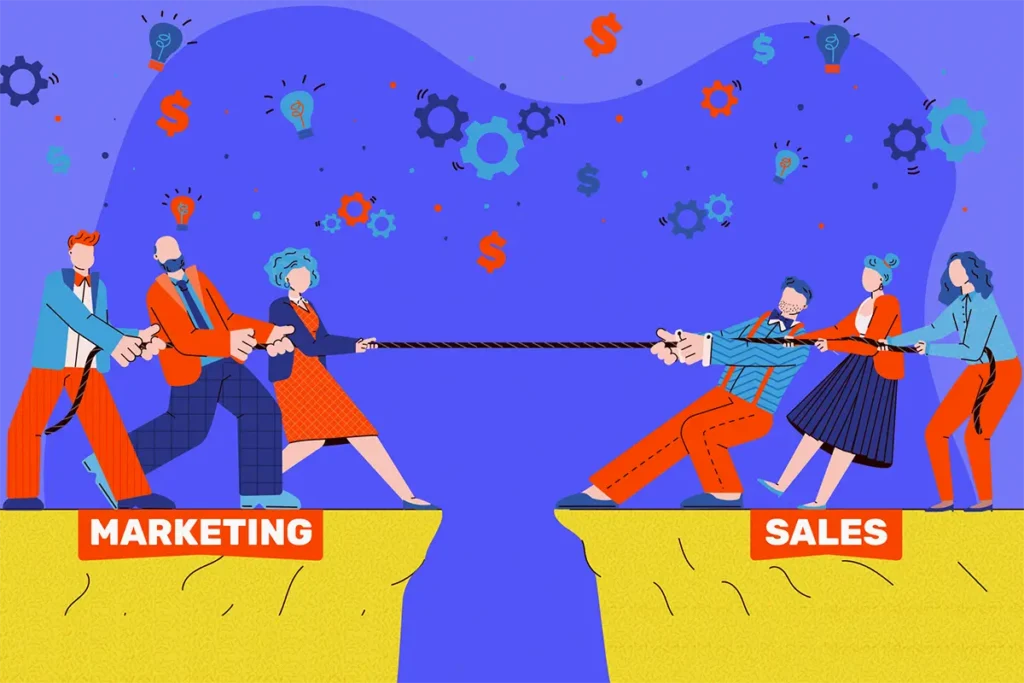
Misalignment between sales and marketing is one of the most expensive pitfalls in B2B. If your sales team does not use your content or cannot see campaign impact, you lose both efficiency and insights.
How to fix it:
Create shared goals and shared definitions of qualified leads. Establish a feedback loop so sales can share what prospects respond to, and marketing can refine campaigns accordingly. When the two teams operate as one revenue engine, conversion rates improve quickly.
Mistake 5: Ignoring existing customers

In B2B, new customer acquisition often takes the spotlight. Yet expanding and retaining existing accounts is almost always more cost effective. When marketing focuses only on net new leads, companies miss significant growth opportunities.
How to fix it:
Build engagement programs for your current customers. Share useful resources, industry updates, and best practices. Highlight new features or services that help them reach the next level. When you continue to provide value, you increase the likelihood of renewals, referrals, and upsells.
Mistake 6: Measuring too many things or not enough of the right things

Some B2B teams track every available metric. Others track very few. Both extremes make it difficult to see what is driving results. Without clear measurement, even good marketing can appear ineffective.
How to fix it:
Choose a small set of metrics that reflect real business impact. Pipeline created, deal velocity, conversion rates, and customer lifetime value are stronger indicators than views or impressions. Focus on metrics you can influence directly and report on them consistently.
Mistake 7: Expecting short term results from long term strategies

B2B buyers often have long evaluation cycles. Building trust takes time. When leadership expects immediate results from content, events, or organic demand efforts, marketers end up pivoting too quickly to see the payoff.
How to fix it:
Set realistic timelines for each tactic. Brand building and content may take months to influence the pipeline, while paid campaigns and outbound can move faster. Align expectations early so your team can stay committed long enough to generate measurable results.
Make It Clear, Intentional, and Buyer Led
B2B marketing does not fail because teams are not working hard. It fails when effort is spread across the wrong priorities. Most of the mistakes above come down to a lack of clarity, alignment, and buyer focus. When messaging is simple, content matches the buyer journey, and marketing and sales operate as one, results become easier to predict and easier to scale.
Strong B2B marketing is rarely about doing more. It is about doing fewer things with intention, guided by real customer insight and clear measurement. The companies that win are the ones that stay disciplined long enough to let smart strategies compound.
Need Help Fixing These Gaps?
If you recognize some of these mistakes in your own marketing, you are not alone. We work with B2B teams to clarify positioning, align marketing and sales, and build demand programs that support real revenue growth, not just activity.
If you want a clearer, more effective B2B marketing strategy, let’s talk. Reach out to start a conversation about where your marketing is falling short and how to fix it.