
Expanding Mental Health Awareness Through Traditional Media
The Village Family Service Center partnered with us to elevate mental health awareness across North Dakota and Minnesota through a sustained traditional media strategy rooted in consistency and trust. Instead of focusing on a single campaign, the work expanded into a connected series of efforts supporting counseling, addiction recovery, and employee assistance programs, each designed to meet people at different points in their journey and reinforce The Village as a steady, familiar presence in the communities it serves.

Invest in Your Brand's Future!
Start with a Customized Strategy Session.
Showing Up Consistently, Not Occasionally
The Village Family Service Center provides behavioral health and community-based services across North Dakota and Minnesota, including counseling, addiction recovery, in-home family therapy, youth mentoring, and employee support programs. Over time, our work together evolved into a series of awareness campaigns designed to meet people at different entry points into care.
Rather than treating mental health outreach as a single moment or message, the partnership focused on sustained visibility across multiple services. The result was three distinct but connected campaigns supporting Counseling Services, First Step Recovery in Fargo, and The Village’s Employee Assistance Program.
A Multi-Campaign Approach Rooted in Trust
Each campaign addressed a different audience and need, but all were built on the same foundation. Mental health awareness works best when it feels familiar, steady, and human.
The strategy prioritized:
- Long-term presence over short-term urgency
- Recognition before action
- Messaging that reflected real experiences rather than clinical definitions
This approach allowed each campaign to stand on its own while reinforcing The Village as a trusted mental health resource across the region.
Why Traditional Media Played a Central Role
Many individuals who could benefit from mental health services are not actively searching online. In rural and conservative communities, familiar media environments often feel safer and more credible than digital spaces.
Digital advertising fatigue has also changed how messages are received. Constant exposure to sponsored content, retargeting, and calls to action has made it easier for important messages to blend into the background. Mental health messaging risks being dismissed when it appears alongside aggressive or transactional advertising.
Traditional media offered a different experience. Billboards, radio, and broadcast television allowed the message to exist without interruption or demand. Encountered during commutes, daily routines, and trusted programming, the messaging felt present rather than promotional.
That sense of legitimacy and authenticity helped establish trust, which was critical for a topic as personal as mental health.

The Counseling Services Campaign
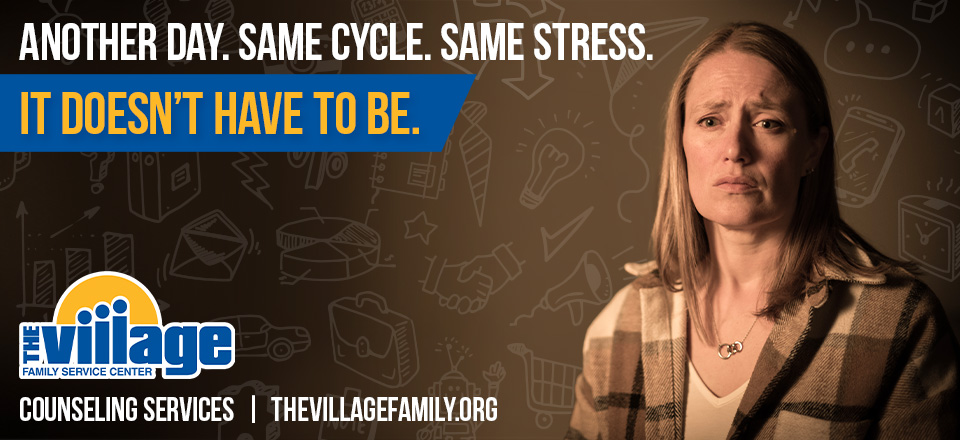
The Counseling Services campaign became the emotional and creative foundation for the broader initiative.
The central idea was simple. Emotional stress often follows people from place to place, regardless of their surroundings.
The creative concept, Same Cycle. Same Stress., followed a woman experiencing the same internal state across multiple environments, including her kitchen, her car, and her workplace. The repetition mirrored how anxiety, depression, and chronic stress often persist throughout the day.
The visuals were intentionally understated. There were no dramatic moments or clinical settings. The focus remained on quiet recognition and emotional truth.
Language That Encouraged Recognition
Messaging for the Counseling Services campaign avoided diagnostic language and treatment-heavy terminology. Instead, it centered on shared experiences and internal thoughts.
Examples included:
- The feeling that follows you everywhere
- When changing your scenery does not change how you feel
- The weight no one else can see
The goal was to reflect what people already feel, not tell them what they should do. Recognition came first. Action could follow later.
Counseling Services Radio Ad
First Step Recovery in Fargo
The First Step Recovery campaign focused on addiction treatment services in Fargo, addressing a deeply personal struggle that often unfolds quietly and over time.
The creative followed a single individual moving through the same day again and again. The same spaces. The same objects. The same coping mechanisms. A drink on the nightstand. A glass in the kitchen. A mug at work. A bar at night. Each scene reflected how substance use can weave itself into daily routines while remaining largely unseen.
The repetition was intentional. The story was not about rock bottom or dramatic turning points. It was about the slow accumulation of weight and the isolation that can exist even when surrounded by others.
The emotional tone centered on:
- Quiet repetition
- Isolation hidden within routine
- The distance between knowing something is wrong and knowing how to ask for help
The turning point was subtle. Instead of reaching for another drink, the individual reached for his phone. The message reinforced that taking the first step does not require certainty, strength, or explanation. It only requires deciding not to go it alone.
This approach positioned First Step Recovery as accessible, human, and ready when someone is finally prepared to reach out, even if that readiness comes after a long internal struggle.
1st Step Radio Ad

Employee Assistance Program Awareness
The Employee Assistance Program campaign shifted the focus from a single individual to the collective experience of stress across the workplace.
Rather than following people directly, the creative centered on what often goes unnoticed. Words written on chalkboards, sticky notes, safety gear, and coffee cups became the primary storytellers. Employees remained slightly out of focus, reinforcing how struggle can exist in plain sight while remaining unspoken.
Each environment reflected a different industry, including education, construction, government, finance, and nonprofit work. Across every setting, the message was consistent. Employees carry more than what appears on their to-do lists.
The emotional tone of the EAP campaign emphasized:
- Shared pressure across roles and industries
- Stress that blends into everyday work environments
- The normalization of needing support
By allowing the message to carry the weight rather than individual stories, the campaign reinforced the idea that mental health challenges are not isolated or exceptional. They are part of the modern workplace experience.
The Village’s EAP was positioned as a quiet layer of support that organizations can rely on, offering counseling, crisis response, training, and organizational resources without stigma or visibility.
This approach helped frame EAP services as a standard, responsible investment in employee wellbeing rather than a reactive solution to crisis.
EAP Radio Ad

Executing With Consistency Across Campaigns
All three campaigns were supported by custom creative developed specifically for traditional media, including original video content, broadcast television spots, radio scripts, and digital billboard executions.
Media placement was intentional across all efforts:
- Digital billboards appeared along high-traffic commute routes
- Broadcast television reached households through habitual viewing
- Radio reinforced messaging during daily routines
Consistency across channels and campaigns reinforced familiarity, making The Village’s presence recognizable across different services and moments.
Evaluating Impact Through Awareness and Positioning
While traditional media does not offer precise attribution, the success of these campaigns was reflected in awareness and perception.
Collectively, the campaigns positioned The Village as:
- Approachable and nonjudgmental
- Present across multiple mental health needs
- A trusted resource within the communities it serves
By showing up consistently across services, The Village reinforced its role as a place people could turn to at different stages of their mental health journey.
Key Takeaways
This multi-campaign partnership reinforced several core principles:
- Mental health awareness benefits from sustained visibility
- Recognition builds trust over time
- Language shapes emotional safety
- Different services require different entry points, not different values
- Traditional media supports credibility and broad community reach
Building Familiarity Across the Mental Health Journey
Together, these campaigns demonstrated that effective mental health marketing is not about a single message or moment. It is about showing up consistently, across services, with care and restraint.
By meeting people in everyday moments and reflecting real experiences, The Village strengthened awareness, trust, and accessibility across counseling, recovery, and workplace support, creating multiple paths into care when individuals are ready to take the next step.